
Keywords are words or phrases that users use to find information in search engines.
In terms of SEO (Search Engine Optimization), these words tell search engines what your content is about.
With the right keywords, you can reach your target audience and make your content more visible.
As a content creator, our goal is to provide the right answers to the questions people are looking for. But in order to do that, we first need to know what they are looking for. This is where keyword research comes into play.
In this article, I will tell you what keywords are, how they match search intent, the power of long-tail words, the competition-volume balance, and, of course, some of my practical experiences.
Contents
1.What is Search Intent?
Search intent refers to the main purpose behind the query a user types into a search engine. It reflects the user’s intentions, such as seeking information, buying a product or service, reaching a specific site, or comparing options.
1.1.How Does Google Understand a User’s Search Intent?
When a person types something into Google, we can guess their intent by looking at the first page results (SERPs). How?
Google shows the most relevant results by trying to guess the intent behind it, not just the keyword. Because Google’s main goal is to serve the user exactly what they are looking for.
By looking at thousands or even millions of past search behaviors with that keyword, Google can predict the intent with which that keyword is usually searched.
1.2.Keyword Types by Search Intent
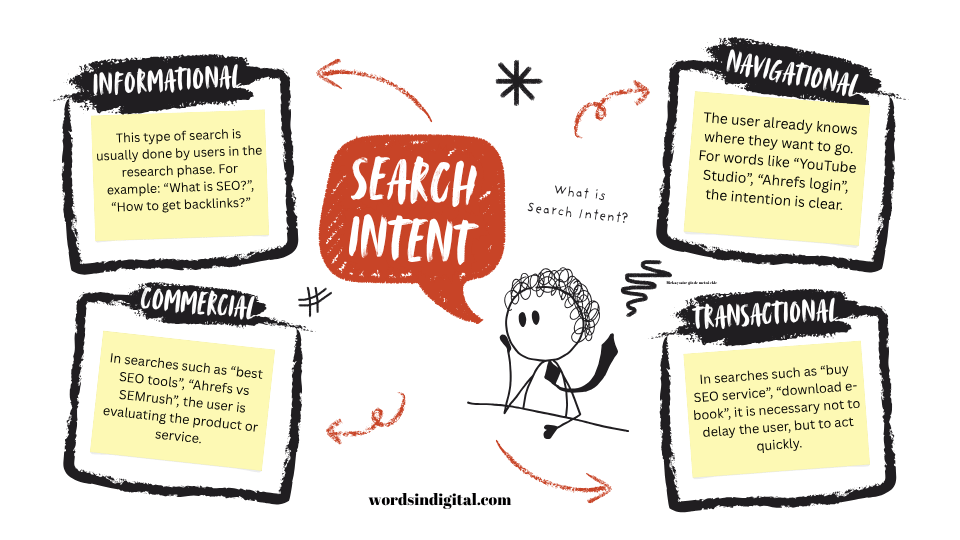
Keywords should be categorized not only by word structure, but also by searcher intent. This sets the foundation for your content strategy.
a. Informational
This type of search is usually done by users in the research phase. For example: “What is SEO?”, “How to get backlinks?”
These people don’t want to buy something right away. You need to guide them. That’s why comprehensive blog posts, guide content, or video tutorials are perfect for these types of words.
b. Commercial (Commercial Investigation)
Here, the user is in a decision-making process.
In searches such as “best SEO tools”, “Ahrefs vs SEMrush”, the user is evaluating the product or service.
I usually write comparative articles for such words and add my recommendation at the end. This is a very effective method to guide the user.
c. Navigational
The user already knows where they want to go. For words like “YouTube Studio”, “Ahrefs login”, the intention is clear.
In these words, competition should be avoided because the user already wants to reach a specific brand. Optimization for these words is to the advantage of brands.
d. Transactional
One of my favorite types of keywords. Because here the user is ready to buy.
In searches such as “buy SEO service”, “download e-book”, it is necessary not to delay the user, but to act quickly.
1.3.How Do We Understand Users’ Search Intent?
If you want to prepare successful content, you need to understand not only what the word is, but also why the user is typing that word. At this point, I would like to talk about a few practical methods:
1.3.1.See What’s on SERP
Type the word into Google. Look at the type of content on the first page: Blog? Product page? YouTube video?
Example: If you type in “best email marketing tool” and you get mostly comparative blog posts, this tells you that the user is in the decision-making stage – i.e., commercial intent: User decision-making – i.e., commercial intent.
1.3.2.Featured Snippets and “People Asked These Too”
These sections give away user intentions. If there are a lot of questions, the user is looking for information. It should find this information in your content.
1.3.3.Google Autocomplete and Related Searches
These have been giving me content ideas for years.
For example, the completions that come up when you type “blog how to…” give you the variations people search for most often and reveal the intent behind them.
1.4.How to Create Content for Search Intent?
Some content creators choose words based on search volume alone. This is a big mistake. Because the competition for that word can be very high.
Here is the strategy I use:
- Low volume but low competition = Target now
- High volume and high competition = Plan for the long term
- Low volume, high competition = Generally, stay away
For example: “email automation campaigns” → 300 search volumes, low competition = Excellent opportunity.
1.5.Bonus Search Intent A/B Testing in SEO
Sometimes the intention of a word can be split into two. For example:
- “SEO training” can include both a desire to learn and a desire to buy.
In this case:
- You can test both a blog post and a sales page with the same keyword.
- You emphasize whichever one brings more traffic/conversions.
1.6. Case Studies
1.6.1. Case Study 1:
Keyword “Protein Powder” (Mixed Intent – Informational + Transactional)
Keyword: protein powder
SERP Review:
E-commerce sites are listed at the top.
At the same time, content such as “What is protein powder?”, “What does protein powder do?” and “Is it harmful?” also appear on the first page.
Comment: This is a mixed-intent keyword. Some users want to learn more, while others want to purchase the product directly.
Content Recommendation:
- In the blog post, first provide basic information such as “what is protein powder?”
- Then add a comparison table, such as “the best protein powder brands.”
- In the last section, include sections such as “where to buy?” and “price comparisons” to direct users to purchase links.
1.6.2. Case Study 2:
“Ahrefs Blog” Keyword (Navigational Intent)
Keyword: ahrefs blog
SERP Analysis:
Ahrefs’ official blog page ranks first.
Other results include content such as “Ahrefs blog post recommendations” on sites like Quora and Reddit.
Comment: This is a navigational search by a user who wants to reach a specific brand or site.
Content Recommendation:
- If you produce similar content, you can attract users with content such as “5 Great Lessons on Ahrefs Blog Posts.”
- However, in such searches, it is difficult to compete with the brand name because the main goal is usually to go to a specific page.
1.6.3.Case Study 3:
“Best Coffee Machine 2025” Keyword (Commercial Investigation)
Keyword: best coffee machine 2025
SERP Review:
List content appears in the top rankings: “Top 10 Coffee Machines,” “Comparative Coffee Machine Guide.”
YouTube video content also ranks high in SERP.
Comment: This is a commercial investigation search. The user has not yet made a purchase decision but wants to compare options.
Content Recommendation:
- Make it easy for users to choose your content.
- Compare products based on technical specifications, price, and user reviews.
- Guide users by adding sections such as “Buying Guide” or “Who is it suitable for?”
- You can earn revenue by using affiliate links.
1.6.4.Case Study 4:
“Buy Nike Air Max 270” Keyword (Transactional Intent)
Keyword: buy Nike Air Max 270
SERP Review:
All results belong to e-commerce pages.
Product prices, installment options, and promotions are prominently displayed in the SERP.
Comment: This is a keyword that conveys transactional intent. The user has already made their decision and simply wants to make a purchase.
Content Recommendation:
- Details such as clear pricing, fast shipping information, and stock availability should be highlighted on your product page.
- The “Buy Now” button should be visible.
- Trust-building elements (reviews, secure payment icons, return guarantee) increase conversion rates.
2.Long-Tail Keywords
2.1.What is a Long Tail Keyword?
Long-tail keywords are search terms that consist of 3 or more words, are more specific, generally less searched, but have a higher conversion rate.
- Short-tail keyword: “diet”
- Long-tail keyword: “karatay diet 1 month list”
Short-tail words are more searched, but very competitive.
Long-tails are more niche, more specific, and easier to rank.
Advantages of Long-Tail Keywords
| Feature | Description |
| Less Competition | Competition is much lower than for short and generic words. |
| More Targeted Traffic | User intent is more specific; content delivers exactly what they are looking for. |
| Higher Conversion Rate | For example, someone who writes “online English for kids” is probably ready to register. |
| Chance to Rank Fast | New sites can get on the first page faster with these types of words. |
2.2.How to Find a Long Tail Keyword?
1. Google Autocomplete
- Type the keyword: “how to blog” → recommendations:
- How to write a blog
- How to start a blog
- How to monetize a blog
2. “Users Also Asked These” and “Related Searches”
- These sections from Google show you real user questions. Each one is a potential long-tail idea.
3. With Keyword Tools
- Ubersuggest: Low volume but captures specialized words.
- AnswerThePublic: Generates long-tail ideas in question format.
- AlsoAsked.com: Shows Google’s “also asked these” network.
Ahrefs/SEMrush: Analyzes long-tail variations + volume + difficulty.
3.Keyword Volume and Competition
3.1.What is Keyword Volume (Search Volume)?
Keyword volume is a metric that shows how many times a keyword is searched for in a given period. It is usually expressed as the average number of searches per month.
For example:
“diet” → 49,500 monthly searches
“ketogenic diet plan” → 18,000 monthly searches
High volume ≠ always high opportunity
Even if the volume is high, it is very difficult to rank if there is a lot of competition.
3.2.What is Keyword Difficulty?
The level of competition shows how difficult it is to rank high for a keyword.
SEO tools show this by scoring:
| Competition Score | Difficulty Level | Strategy |
| 0-10 | Very Easy | Target and produce content |
| 11-30 | Easy | Ideal for startup sites |
| 31-70 | Medium – Difficult | Authorized sites can target |
| 71-100 | Very Difficult | Suitable for domains with high authority |
3.3.How to Decide on the Balance Between Volume and Competition?
The matrix below makes it easier for you to decide:
| Volume | Competition | Proposed Strategy |
| High | High | Difficult but worthwhile – need content quality + backlinks |
| High | Low | Rare opportunity – should be targeted immediately |
| Low | High | Generally not worth it – can be a waste of time |
| Low | Low | Niche traffic – ideal for beginners |
Tip: Long-tail words with volume less than 1000 but low competition are the springboard for small blogs.
3.4.Keyword Tools
Here are some popular tools that make keyword research easier:
| Vehicle | Free Version | Features |
| Google Keyword Planner | ✅ | Volume & insights based on Google ad data |
| Ahrefs | ❌ | Large database, keyword difficulty, clickstream data |
| SEMrush | ❌ | Competitive analysis, content ideas, and keyword variations |
| Ubersuggest | ✅ | Neil Patel’s car is ideal for low-budget jobs |
| KeywordTool.io | ✅ | Recommendations focused on Google Autocomplete data |
Each tool has different strengths. It is a good method to use several of them together according to your goals.
4.What to Do to Avoid Keyword Stuffing Penalties?
4.1.What is Keyword Stuffing?
Keyword stuffing is the practice of inserting keywords into content excessively and unnaturally. Search engines like Google recognize this behavior as manipulation and may issue ranking penalties.
Example (Misuse):
“If you are looking for the best laptop, you can find the best laptop brands and the best laptop models in this best laptop guide. Read our best laptop advice to choose the best laptop.”
In this example, the keyword (“best laptop”) is used artificially and repeatedly. Google detects this easily.
4.2.Harms of Keyword Stuffing
| Harm | Description |
| 🚫 Loss of Ranking | Google penalizes: you fall off the first page |
| 👎 User Experience | Impairs readability, increases page bounce rate |
| 📉 Loss of Trust | The reader perceives the article as “ad-scented” content |
| 🕸️ Internal Connection Value Decreases | The page does not get links because it is not considered valuable |
5.The Right Strategies for Keyword Usage
1. Use Semantic Variations
Google now looks not only at the keyword, but also at its meaning.
Example:
- Keyword: “how to start a blog”
- Alternatives
- Setting up a personal blog
- Start a blog from scratch.
- Steps to create a blog
2. Add LSI (Latent Semantic Indexing) Words
Words used in the natural context of the keyword:
Example: LSIs in the article “brewing coffee”:
- ground coffee
- french press
- water temperature
- brewing time
3. Natural Proportion Rule: 1-2
According to the general opinion of SEO experts:
- In 1000 words of content, the main keyword should be mentioned 10-20 times at most.
- Use in headings, subheadings, and anchor text instead of excessive repetition.
4. Distribute the Keyword to Strategic Points
Keyword Placement Check Table
| Section | Is Keyword Usage Necessary? | Description |
| URL | Yes | In a short and descriptive form |
| Title (H1) | Yes | The main topic of the content should be visible |
| Meta Description | Yes | Creates a summary that stands out in search results |
| First Paragraph | Yes | Address the user directly |
| Subheadings (H2-H3) | Yes | Use in a way that enriches meaning |
| Visual ALT Tags | Optional but useful | Contributes to visual SEO and accessibility |
| Internal Connections | Yes | Should be used in meaningful anchor texts |
Case Analysis: “Online English Course” Content
Bad Example (Keyword Stuffing):
Here is a list of the best online English courses for those who want to take an online English course. You can easily learn English with an online English course…
Good Example:
If you want to start learning English, an online English course can be a very effective option. Especially platforms with live lessons maximize the user experience. In this article, we have compiled the most prominent courses for you.
6.Conclusion Understanding the User is the Key to Winning in SEO
As a digital marketing expert, I can tell you this clearly:
Search engines change, and algorithms are updated. But people’s intentions are always looking for one thing: Relevant and satisfying content.
Keyword research is the most effective way to understand this intent. If you get it right, you’ll not only be writing on your blog, you’ll be writing in people’s minds.
Remember: SEO is not just writing to Google, it’s talking to people.

 Share
Share X
X ChatGPT
 Perplexity