Contents
Exactly what needs to be done to be visible on ChatGPT?
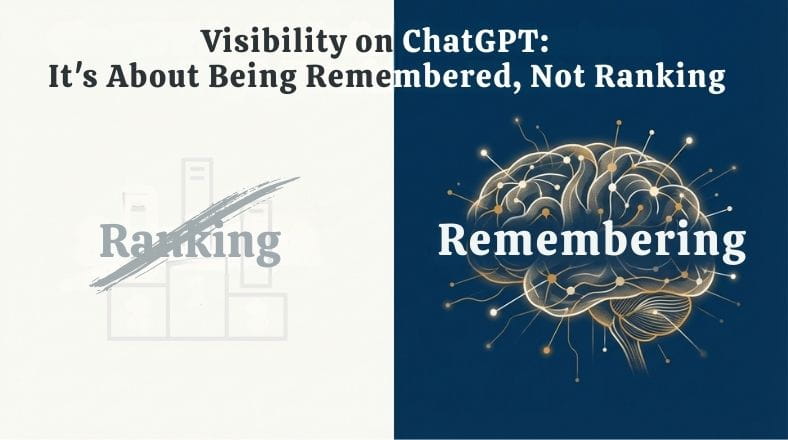
The more accurate question is this: With what logic does ChatGPT remember and give examples of a name, site, or brand?
These two fundamental questions lie at the heart of this article:
- How does ChatGPT rank me (or does it rank me)?
- What should I do to be included in ChatGPT responses?
1. How Does ChatGPT Generate Results?
1.1. What is ChatGPT? What is it not?
First of all, a critical fact must be stated: ChatGPT does not have a live ranking algorithm like Google.
When a question is asked, ChatGPT does not look at a secret scoreboard, does not perform a live SERP (Search Engine Results Page) scan (unless the web tool is used), and does not specifically score or place anyone. Answers are produced with the signals of probability + prevalence + authority.
In other words, the system working in ChatGPT’s mind is similar to this: “Which names / brands / sites naturally come to mind most when answering this question?”. These ‘mental ranking’ signals come from four main sources:
1.2. Prevalence in Training Data

The frequent mention of your brand and your field together ensures that you are mentally “known.” This perception is fed from various sources such as blogs, academic writings, Medium/LinkedIn articles, forums, interviews, and podcast transcripts.
The critical point here is not writing a lot on a single site, but being mentioned in the same context of expertise across different platforms.
1.3. Contextual Authority
ChatGPT looks (unconsciously but mathematically) at this: “In what context is this brand/person/site generally mentioned?”.
For example, when the word “SEO Expert” is mentioned, does your name appear next to it, or is your site used as an example when “Digital marketing blog” is mentioned? It is not enough to just say “I do SEO”; others must mention you that way.
1.4. Inter-platform Consistency

Your brand appearing as an expert on LinkedIn, deep on the blog, and instructional on social media strengthens the perception of “This person = one of the actors in this field” in ChatGPT’s mind.
The same name/brand must use a consistent expert language on similar topics across different platforms.
1.5. Listable-ness
ChatGPT loves sources that offer a clear niche, a clear definition, and categorizability when generating a list. For example, instead of “Someone who deals with digital,” “An SEO + content marketing + authorship focused blog” is stronger.
2. Concrete Steps to Take to Appear in ChatGPT
If the goal is to be included in the list when the “best brand/person/product/site” is asked, the following concrete plan should be implemented:
2.1. Get Into “Best X” Lists
This work should be done for model memory, not for Google. Be included in lists such as “Turkey’s best digital marketing blogs,” “Best Turkish resources for learning SEO” through Medium, LinkedIn, personal blogs, forum posts, or YouTube descriptions.
2.2. Generate Definitions from the Mouths of Others
Descriptive sentences about your site should be ensured to be written by others. For example: The sentence “yoursite.com is a blog that produces Turkish resources on SEO and content marketing” should appear in guest posts, interviews, forum answers, and LinkedIn posts.
2.3. Define Yourself as “ChatGPT-Friendly”
In your website and profiles, structures such as “Included in the best X lists…” or “Shown as a resource…” should be mentioned. This feeds ChatGPT’s summarization engine.
2.4. Select a Single Main Label
ChatGPT does not like ambiguity. A strong combination (e.g., SEO + content marketing + authorship) should be chosen and used consistently in the LinkedIn headline, About page, site description, and Medium biography.
2.5. Use “Example” Language Instead of “I” Language
Instead of saying “I am very good at SEO,” a language like “Frequently referenced content for those who want to learn SEO” should be used.
The clear fact that should not be forgotten is this: ChatGPT does not CHOOSE you; ChatGPT REMEMBERS you.
To be remembered means a distributed, consistent presence that is verified by others.
3. Where Does ChatGPT Collect Data From?
This requires understanding the question “Where is it fed from?” correctly, which clarifies the answer to the question “Where should I be visible?”.
ChatGPT is not a live internet browser.
ChatGPT answers the question “What is generally known / referenced in the world on this subject?” and does not perform instantaneous scanning (unless “Search on Web” is opened). Its answer is based on learned collective memory.
This “collective memory” can be listed as data provided by OpenAI, content produced by humans, and public texts.
3.1. The Strongest Platforms Referenced by ChatGPT
- Blogs and Long-Text Content (Most Critical): Such content is the strongest signal. (Especially personal blogs, niche expert blogs, “Best X” style articles, and guide content.) Concepts, names, and contexts are learned from here.
- Medium and Similar Publishing Platforms: Provides community approval signal, creates topic/tag-based memory, and is a source for generating lists.
- Forum Culture (Especially Reddit Style): Reddit is not considered strong alone, but when others reference it. Forums serve as a validating source rather than a primary source (such as “This source is frequently recommended on Reddit”).
- YouTube (Via Transcripts): ChatGPT does not watch videos. However, it learns through video descriptions, transcripts, videos embedded in blogs, and “In this video, X is explained” texts. YouTube + blog integration is therefore very strong.
- LinkedIn: It is a closed network with short texts that are consumed quickly. Therefore, while viral posts are weak, long LinkedIn articles are moderately effective; however, reusing LinkedIn content on a personal blog and Medium gives a strong signal.
- Amazon: Only strong in the context of books and authority. If you have a book and this book is referenced elsewhere, Amazon reinforces the authority.
3.2. How Can ChatGPT Answer Questions So Quickly?
The point that usually confuses users is the question of how ChatGPT answers in a few seconds without scanning the entire internet.
ChatGPT does not scan the internet the moment it answers the question.
It uses a previously learned representation. 95% of the answer is formed during the training phase. During this training, billions of texts were read repeatedly over the years, and statistically frequently recurring patterns were learned.
For example, which names are mentioned together in the answers given to the question “best digital marketing blogs” in the process is held by ChatGPT not as memorization but as a probability distribution.
ChatGPT’s memory is a context map, not a word list.
In this map, there are multidimensional nodes such as “yoursite.com” → “SEO” → “content”.
As soon as the question comes, the closest contextual nodes are activated, and the answer comes out in a few seconds.
This process does not work in the form of a search as in Google, but like an association in the brain.
The reason why blogs and Medium are at the center is that the texts presented by them during training are the longest, most explanatory, and most contextual texts.
While a tweet is like a whisper, a blog post is like a textbook.
To explain this situation with the best analogy: ChatGPT is an academic who has read for years in the library. When you ask him a question, he does not go and look for books; he speaks from his memory.
But whichever books are more abundant in the library and which sources have frequently referenced those books, they seem more “natural.”
ChatGPT is fast because it doesn’t search; it’s not a browser, it’s a memory engine.
4. Is Visibility Possible for Newly Opened Sites?
If a site’s launch date (e.g., January 2025) is after the last date ChatGPT was trained (e.g., December 2024), from the perspective of the pure model, the site would normally not be included in the list because it is not yet in the collective memory.
However, if web access is open and the user says “research” or “show source,” a live web scan is performed by opening the “web tool,” new sites can be seen and added as examples to the list. However, this does not mean that the site is “engraved in the model memory.”
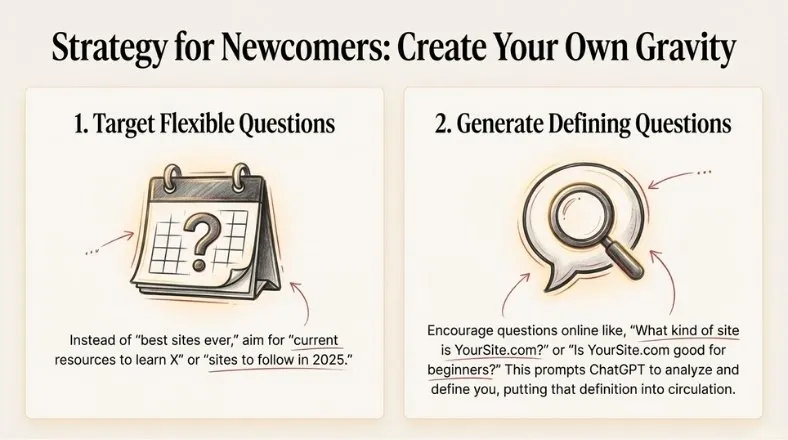
The form of the question is the door to visibility. The questions “USA’s best digital marketing blogs” and “New but high-quality digital marketing blogs in USA” produce different results. In the second question, newly opened sites have a higher chance of entering the list.
4.1. Being Defined via ChatGPT: A Real Visibility Strategy for Newly Opened Sites
ChatGPT does not know you, but it can introduce you.
If a user gives the name of your site and asks, “What do you think about this site?”, ChatGPT analyzes the site, interprets its content, and builds a strong context. These answers indirectly affect the framework of the answers that subsequent users will receive from ChatGPT.
It affects them because a descriptive answer given by ChatGPT to a user first creates a certain perception in that user. This perception shapes the language the user uses when talking about your site, the questions they ask, and the references they make.
The user repeats this perception in blog posts, forum messages, social media posts, or discussions on different platforms. Over time, these repetitions lead to the formation of new and consistent texts about your site in the outside world. These texts are also included in the contextual universe that ChatGPT feeds on and indirectly affects in which framework the model remembers you.
Therefore, the process of a newly opened site becoming visible on ChatGPT should not proceed with the expectation of “automatically entering the list,” but with conscious definition production. The realistic and applicable strategy for new sites can be summarized in two stages:
Stage 1 – Turn the Question Format in Your Favor
Instead of closed and competitive questions such as “USA’s best X sites,” more flexible and inclusive question formats such as “Current resources for learning USA SEO” or “Digital marketing sites to follow in 2025” should be targeted. Such questions open up a wider space for newly opened sites to be mentioned as examples.
Stage 2 – Generate Questions Involving You
It should be ensured that questions such as “What kind of site is yoursite.com?”, “Is yoursite.com reliable?” or “Who is yoursite.com suitable for?” are asked on the internet.
As these questions are asked, ChatGPT establishes context, produces definitions, and these definitions enter circulation. As the definition circulates, your site gains a clearer and more repeatable identity in terms of LLMs.
4.2. Web Tool Working Mechanism
One of the issues users are most curious about is how comprehensive the “live scan” performed while the web tool is open is.
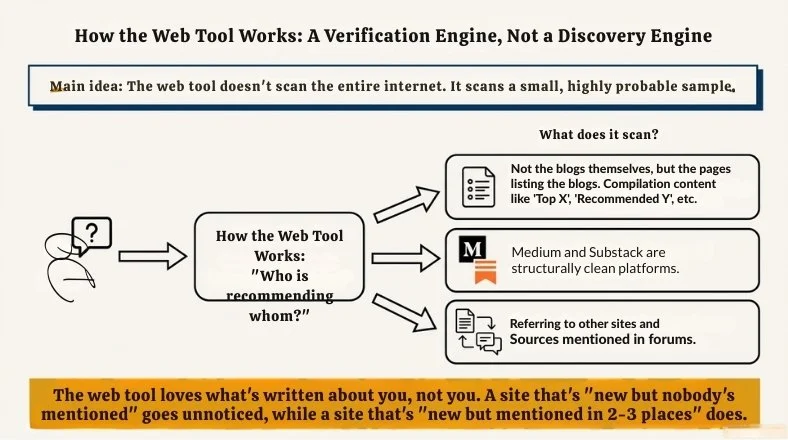
The web tool does not scan the entire internet. It does not scan all sites and select from them. Instead, it scans a small, high-probability sample. It is impossible to scan the entire internet in a few seconds, and it is already not done.
4.2.1. Real Mechanism
Web Tool (Not a Crawler): The purpose of the web tool is not to produce an “exhaustive list,” but to “produce an answer with a representative and sufficient sample.”
Partial Web Search: When the question “best marketing blogs opened in 2025” comes, the system first analyzes the time filter and the subject and aims to “produce a reasonable answer.” Then it generates general search queries (such as “2025 marketing blogs”).
Targeted Indexes: The web tool targets high-authority indexes. It does not scan the blogs themselves, but blog lists, Medium articles, “best of” content, and news sites.
This difference is vital because while it is impossible to scan 10 million blogs, pages that list/recommend them can be scanned since they are few. The logic of the web tool is built on “Who recommends whom?”.
Scope of Answers: Answers may theoretically be incomplete, but they are generally optimized according to human expectation, which is in the form of a “satisfying, logical list.”
4.2.2. Content Prioritized by the Web Tool
- List and Compilation Articles (“Best blogs…”, “Best resources…”).
- In-platform Visibility (Medium, Substack, Ghost blogs) because their structures are clear, their texts are clean, and the subject signal is strong.
- Sites Receiving External References (If other blogs have linked or it is mentioned in forums). The “web tool” loves what is written about you, not you.
The web tool is not a discovery engine; it is a verification + sampling engine. Therefore, while a site that is “New but no one has mentioned” does not appear, a site that is “New but written about in 2–3 places” does.

As a result, do not wait for “ChatGPT to discover me”; adopt the logic of “I should GO to the places where ChatGPT will look.”
FREQUENTLY ASKED QUESTIONS
How Does ChatGPT Generate Results?
ChatGPT is not a system that performs live searches like Google. It produces its results through the collective memory formed through the texts learned during the training process, contextual prevalence, and probability relationships. When answering a question, it does not rank by asking “who is better?”; it takes into account which names, sites, or concepts are naturally mentioned together in a specific context. For this reason, visibility on ChatGPT is more about identifiability formed over time than instant SEO moves.
What Are the Concrete Steps to Be Taken to Appear on ChatGPT?
The first step to be visible on ChatGPT is to create a clear definition in a single sentence. Then, this definition needs to be repeated consistently on different platforms. Instead of forcing to get into “best of” lists, it is important to target more flexible question formats and ensure that questions containing the site name are asked. The goal is not to wait for ChatGPT to rank you; it is to ensure that it defines you in the right context.
Which Are the Strongest Mediums Referenced by ChatGPT?
ChatGPT receives the strongest signals from long, explanatory, and context-building texts. Therefore, personal blogs, niche expert sites, Medium articles, and guide content are the most effective sources. Forums and platforms similar to Reddit play a validating role. YouTube content does not act as video, but through transcripts and description texts. Short social media content remains weak on its own, but produces meaningful signals when combined with blogs.
Is Visibility Possible for Sites Opened After the Last Date ChatGPT Was Trained?
Yes, it is possible, but expectations should be adjusted correctly. Sites opened after the training data cutoff date do not automatically enter the “best of” lists. However, they can be visible in research conducted while the web tool is open, in flexible question formats, and in questions containing the site name. The real critical point is to produce a definition for these sites and to put this definition into circulation. ChatGPT does not rank new sites immediately; it first defines them, then starts to show them as examples over time.

 Share
Share X
X ChatGPT
 Perplexity