
Contents
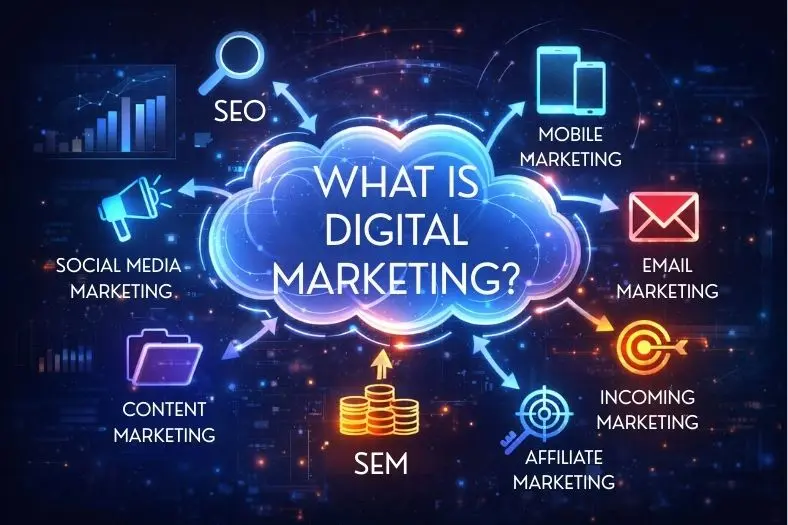
Digital marketing is a data-driven marketing approach that aims to reach the target audience, interact with them, and generate conversions through websites, search engines, social media, e-mail, and advertising platforms.
Digital marketing is not a preference for businesses; it is a strategic tool that burns the budget when done incorrectly, and provides rapid growth when done correctly.
1. Scope of Digital Marketing
Digital marketing encompasses more than internet marketing, as it can also be done through non-internet channels such as television (TV), radio, and SMS. Because this scope includes digital and network communication technologies, including phones and television, digital marketing is more inclusive than internet marketing.
The development of digital marketing has progressed from an advertisement-focused technique to the concept of creating an experience that interacts with customers.
2. Differentiation from Traditional Marketing and Strategic Advantages
Digital marketing offers significant strategic advantages compared to traditional marketing methods and has fundamentally transformed the way business is conducted.
Feature | Traditional Marketing | Digital Marketing |
Targeting | Broad and general audiences (Ex: All TV viewers) | Micro-targeting (Ex: Women aged 25-30 living in Istanbul, who own a cat). It offers marketers the opportunity to focus their work on reaching specific audiences. |
Reach Area | Regional or Local (Limited) | Global (Access from all over the world). |
Measurability | Difficult and slow(Reliance on surveys, complex analysis). | Precise and Real-Time. Click, impression, and conversion numbers are presented with clear data, and detailed reporting is possible. |
Cost | Generally high (TV and print costs). | Less Costly, suitable for every budget. |
Communication Direction | One-way (Brand speaks, consumer listens) | Two-way (Consumer comments, shares, talks to the brand). |
Timing/Flexibility | Starting and changing a campaign takes time, requiring long-term planning | Intervention can be instantaneous. A non-performing ad can be stopped in seconds; it offers the possibility of quick setup and campaign launch. |
Viral Potential | Has no ability to go viral | Has the ability to go viral |
Key Advantages Provided for Businesses:
Digital marketing is critical, especially for small businesses, to reach customers at more affordable costs and compete with larger businesses under tough market competition conditions.
It enables businesses to make prices very open and transparent. It is the process of building brand awareness, strengthening customer relationships, and improving user experience.
When done correctly, it reduces the business’s customer acquisition cost, builds brand value, and ensures measurable growth.
3. Core Components and Channels of Digital Marketing
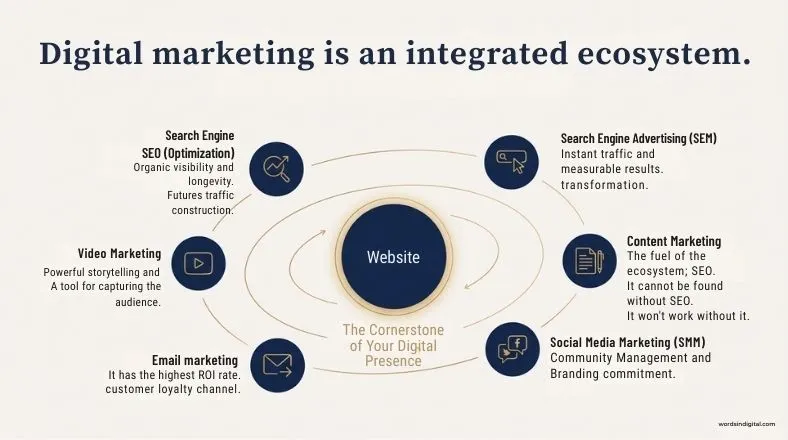
Digital marketing is not a single channel but an ecosystem that works integratively; a successful strategy depends on these channels working in harmony.
1. Website
It is the cornerstone of a brand’s digital presence. A professional, user-friendly, and mobile-compatible website reflects the brand’s identity, promotes products and services, interacts with potential customers, and is central to the strategy.
2. Search Engine Optimization (SEO)
It is the process of increasing your website’s visibility in organic (free/algorithmic) search results.
SEO is one of the most economical methods for long-term traffic building, but requires patience and discipline. A large part of internet traffic starts from search engines.
Technical SEO: Includes tasks such as site speed, mobile compatibility, structured data, the site’s code structure, and crawlability.
Content SEO (On-Page): Covers efforts to analyze keywords, produce quality content, title tags, improve site content, and increase relevance.
Link Strategies (Off-Page): External factors that increase authority, such as references received from other sites (backlinks) and social media signals.
3. Search Engine Marketing (SEM / PPC)
SEM encompasses paid search advertisements (like Google Ads) and promotes websites by increasing rankings and visibility on search engines.
It immediately provides traffic and measurable conversion; however, traffic stops when the budget runs out. SEM uses both paid and free (organic) tactics such as PPC (pay-per-click) listings, content-based advertisements, and paid inclusions.
4. Content Marketing
It is the strategy of producing and presenting content that provides value to the target audience.
Instead of trying to sell directly; it is about creating brand loyalty by offering content that adds value, educates, or entertains the target audience.
Content is the fuel for digital marketing and SEO. Without good content, SEO cannot be done, and without SEO, your content cannot be found.
Typical Formats: Blog posts, guides, videos, infographics, podcasts, e-books, webinars, case studies, white papers, and sectoral reports.
5. Social Media Marketing (SMM)
It is used for brand awareness, community management, and traffic redirection.
Platforms: Instagram, Facebook, LinkedIn, X (Twitter), YouTube, TikTok.
Content planning, paid social ads, and organic engagement-focused efforts are necessary.
SMM is an important factor in building brand loyalty and creating long-term customer relationships.
Organic Social Media: Builds trust and long-term relationships through interacting with followers and posting regularly.
Paid Social Media: Provides fast results by reaching potential customers with targeted advertisements (Ex: Instagram story ads).
6. E-mail Marketing
It is one of the most effective channels for generating conversion and customer loyalty, and one of the channels with the highest ROI (Return on Investment). It is a direct communication channel that provides the opportunity to reach potential and existing customers.
The keys to successful e-mail campaigns: Segmentation, automation, personalized flows, and value-focused content.
Examples: New product announcements, newsletters, cart reminders (“You forgot products in your cart”). It offers low setup and distribution costs.
7. Video Marketing
It is a tool for capturing the audience and strengthening the narrative on platforms like YouTube, TikTok, and Instagram Reels.
It works effectively in the format of product introductions, educational videos, and storytelling. It can vary from short promotional content to long informative videos.
8. Display and Programmatic Advertising
Banner, video, and native advertisements can be delivered to wide audiences using programmatic buying methods (example: Google Display Network (GDN)). It is suitable for targeting, retargeting, and brand awareness campaigns. Programmatic uses advertising technologies to buy and sell digital advertisements using automated and efficient processes.
9. Affiliate and Influencer Marketing
Affiliate: Sales channels are diversified through partnership programs and influencer collaborations. It is an online relationship where the seller pays the affiliate a commission for directing potential consumers to the seller’s website.
The correct match and result measurement are critical, and measurable sales returns should be sought, not just visibility. It is performance-based; if there is no sale, there is no payment.
Influencer Marketing: Promotions made through social media phenomena or digital content producers enable brands to gain credibility.
10. Mobile Marketing
It enables direct reach to mobile users through mobile applications, push notifications, SMS/MMS, WhatsApp marketing, and location-based (Geo-fencing) marketing.
With location-based marketing, a special offer can be presented to a customer when they approach your store. Thinking mobile-first means optimizing the user experience for mobile.
11. Inbound Marketing
It uses marketing tactics that try to attract potential customers to the business (website) by developing high-quality content, instead of trying to gain their interest and convey an advertising message to them.
4. Developing a Digital Marketing Strategy and Frameworks
Making random social media posts does not mean doing digital marketing; success requires strategic planning.
4.1. Strategy Development Steps
Following these steps will be practical and effective when creating a digital marketing strategy:
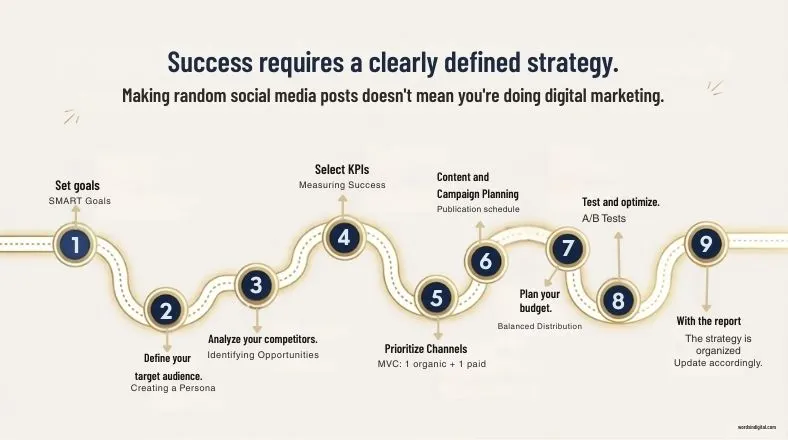
1. Determining Goals: Define SMART goals (Specific, Measurable, Achievable, Realistic, Time-bound).
Is it brand awareness, lead generation, or concrete sales goals, such as increasing sales from the website by 20% within the next 3 months?
2. Target Audience / Persona Definition: At the center of digital marketing strategies is “who” you are marketing to. The answer “everyone” means “no one”.
A hypothetical profile (Persona) of your ideal customer should be created by analyzing demographics (age, gender, location, income), psychographics (interests, hobbies, values), and behavioral data (which sites they visit, what influences their purchasing decision).
3. Competitor Analysis: Opportunities are identified by examining competitors’ digital assets, the channels they use, content strategies, and advertising campaigns.
4. KPI Selection: Key Performance Indicators (KPIs) such as traffic, session duration, conversion rate, cost per acquisition (CPA), and lifetime value (LTV) should be determined.
5. Channel Selection: Prioritize channels according to the goal. The dynamics of every platform (Instagram, Facebook, LinkedIn, X, etc.) are different. Minimum Viable Channel (MVC) selection is recommended: 1 organic + 1 paid channel.
6. Content and Campaign Plan: Content to be published, when, and for which goal is planned in advance. Keyword analysis and SERP intent (the user’s search purpose) analysis should be conducted.
A variety of content formats (long guides, short blogs, videos, visuals) and a publishing calendar should be created.
7. Budget Planning: A balanced plan should be made for advertising, content creation, tools, and team budgets.
8. Testing and Optimizing: Strategies should be tested with A/B testing, data analysis, and rapid cycles.
For example, is a “Red Button” or a “Green Button” clicked more often in an advertisement visual? You increase efficiency by testing this.
9. Reporting: Performance reports should be prepared regularly, and the strategy should be updated.
4.2. Marketing Funnel
Digital marketing strategies rely on the Marketing Funnel structure, which consists of a series of stages designed to attract potential customers, engage them, and guide them to the final conversion.
Mapping the customers’ buying journey (awareness → consideration → decision) is mandatory.
Stage | Location in Funnel | Explanation and Purpose | Content and KPI Examples |
|---|---|---|---|
Awareness | Funnel Mounted (TOFU) | Realizes customer problem, seeks solutions. The goal is to help customers identify their problems. | Blog posts, social content, videos, infographics, LinkedIn posts, industry statistics, short videos. Traffic. |
Evaluation | Middle (MOFU) | The customer has identified the problem and actively explores the solution options. The goal is to prove the brand’s expertise, build trust and create a potential customer (Lead). | Comparison guides, case studies, demo demands. In-depth guides, product comparison charts, webinars, surveys. KPI: E-newsletter memberships, website review. |
Transformation | Funnel Six (BOFU) | The buyers have completed their research and are ready to perform the final action (purchase, registration). The goal is to reduce risk and make it easier for the customer to decide. | Offers, discounts, free trials, direct sales page. Customer references/comments, price comparison charts, limited-time offers. KPI: Sales, Conversion rate. |
Today, buyer journeys are no longer linear; customers can often skip directly to the middle or bottom parts of the funnel instead of entering at the very top.
4.3. Nuances of B2B and B2C Strategies
The digital marketing strategy is fundamentally divided into two categories according to the commercial structure of the target audience: B2B (Business-to-Business) and B2C (Business-to-Consumer).
Criteria | B2B (Business-to-Business) | B2C (Business-to-Consumer) |
|---|---|---|
Sales Cycle | It is long and deliberate (Week or months); more than one stakeholder (IT, Finance) participates. | Short and operational (Complete within minutes or days); usually a single receiver. |
Decision Mechanism | Logic-oriented, ROI requires risk analysis and budget justification. | It is based on emotions, desires and personal needs; it is taken with emotional or impulsive triggers. |
Content Strategy | Educational, technical, data-driven, trust building (White papers, case studies, webinars). Purpose: Feed potential customers and support sales team. | Visual, short, emotional resonance (Social videos, lifestyle visuals). Objective: To attract attention and promote fast action. |
Personalization | It is based on roles and sectors. | It is based on behavioral and interest. |
Channel Preferences | LinkedIn, webinars, email, events. | Instagram, YouTube, TikTok, search ads. |
Transaction Value | High-value and long-term deals. | Usually lower-priced and one-time purchases. |
5. Measurement, KPIs, and Analytics Management
Digital marketing makes data-driven decisions thanks to its measurable nature. Data is reliable when analytical tools are set up correctly. Tracking errors can mislead both the budget and the strategy.
5.1. Key Performance Indicators (KPIs)
KPIs indicate whether strategic goals are converted into operational success.
KPI Category | Criteria and Explanations |
|---|---|
Traffic Metrics | Website Traffic: The total number of visits in a specific period of time. Organic, paid, reference and social traffic. Average Time to stay on the page. |
Conversion Metrics | Conversion Rate (CR): Shows how many percent of visitors have completed the desired action (purchase, registration). In e-commerce, this rate is usually between 1.5-3%. Form filling, purchasing, demo request. New Customer Candidates (Leads) and Qualified Customer Candidates (SQLs). |
Cost Metrics | CPC (Cost Per Click,” CPM (Cost Per Viewing Cost). CPL (Majority Per Customer): Dividing the total advertising cost into the number of potential customers produced. CPA (Maint Cost): The total advertising cost to convince a potential customer to buy the product. ROAS (Advertisement Extortion): Each unit spent measures the income earned for advertising expenditure. |
Interaction Metrics | Click Rate (CTR): The percentage of people who click on the link in an advertisement or content. Get out of here now. Interaction Rate: Likes, comments and sharing rates in social media posts. |
Customer Value Metrics | CAC (Customer Acquisition Cost): Average cost spent to earn a new customer. LTV (Customer Lifetime Value): It measures the continuous value a customer brings to the company. Retention Rate and Attrition Rate. Net Recommendation Score (NPS): Measures customer loyalty/satisfaction; NPS above zero is considered well. |
Return (ROI) | Content Marketing ROI: Compares the revenue generated by content programs with the total investment. |
5.2. Advanced Measurement Models
The complex strategies used to measure how content affects the sales cycle are:
Attribution Modeling: Refers to allocating a share of the sale to each of the different marketing channels a customer encounters on their purchasing journey, according to specific rules.
For example, a position-based model considers the touchpoints at the beginning and end of the journey more important.
Marketing Mix Modeling (MMM): Used to understand how different channels contribute to revenue, instead of tracking individual buyer behavior, and accounts for the effects of external factors like economic conditions.
Incrementality Testing: Reveals the true impact of marketing efforts by comparing it to what would happen without those efforts.
6. Technological Integration, Tools, and Application
Fundamental tools and technologies (Martech) are available today that you can use while growing your business. Choosing the right tool depends on your goals and budget; the priority for small businesses is usually analytics, e-mail, and social planning tools.
Category | Vehicle Examples | Function |
|---|---|---|
Analytical | Google Analytics, Google Search Console, Microsoft Clarity. | Analyzes website traffic, user behavior, target audience, conversion and visit analysis. |
Advertisement Management | Google Ads, Meta Ads, Microsoft Ads. | Plans and analyzes search engine ads and social media ads. |
Email & Automation | Mailchimp, HubSpot, Klaviyo. | Manages email marketing campaigns, segmentation and automation streams. |
SEO & Keyword | Ahrefs, SEMrush, Moz. | Keyword search volume, trends, backlink and traffic analysis perform critical functions. |
Social Planning | Buffer, Hootsuite, SproutSocial. | Creating content calendars and planning and reporting social media posts. |
Test & Optimization | Optimizely, VWO. | It allows you to perform A/B testing on landing pages and advertisements. |
7. Common Mistakes and Legal Compliance
7.1. How to Avoid Common Mistakes?
Goal Ambiguity: Campaigns run without defining a goal consume budget unnecessarily. Every campaign must have a primary KPI.
Lack of Data / Misleading Tracking: Conversion tracking errors lead to incorrect decisions.
Dependence on a Single Channel: If there is a problem on a single platform, the business stops. Channel diversification is essential.
Not Investing in Content: While short-term traffic is gained only through advertising, long-term content investment should not be neglected.
Misunderstanding the Target Audience: Personalization according to segments is required instead of a single “general audience”.
7.2. Data, Privacy, and Legal Compliance
Data protection regulations such as KVKK (Law on the Protection of Personal Data) and GDPR (General Data Protection Regulation) affect user data collection and storage processes. These regulations mandate that personal data be processed and protected in accordance with the standards of the age.
Mandatory Requirements: Establishing cookie consent panels, data processing agreements, and explicit consent mechanisms is mandatory.
Consent in E-mail Marketing: Using permitted lists and providing ease of opting out (opt out) in e-mail marketing protects reputation and is mandatory.
Differences in B2C and B2B Data Processing:
B2C Marketing: Obtaining active consent is always a fundamental requirement for the processing of personal data.
B2B Marketing: Explicit consent is not mandatory when processing business data. If the company has a basis of Legitimate Interest, it can send marketing e-mails to business e-mail addresses.
8. Looking Ahead: Trends and Preparation
The digital world is not static; digital marketing will continue to transform as technology develops.
1. Artificial Intelligence (AI) and Automation:
Artificial intelligence will popularize personalized advertisements, chatbots, and automated campaign management, and will speed up workflows for text production, content recommendation engines, and data analytics.
Artificial Intelligence can reduce content creation time by 30% to 50% by accelerating text writing, visuals, and video production.
It enables hyper-personalization at scale by offering dynamic product recommendations and specially tailored messaging.
It also speeds up the creative campaign creation process, potentially reducing the time-to-market for assets by up to 50%.
Risks: If there is bias in the data AI is trained on, the outputs will also carry bias. This situation can lead to skewed targeting and reputational damage. It is necessary not to allow automation to completely replace the human touch.
2. Privacy, Cookie-less Future, and Data Modeling: With the decline of cookies, server-side tracking and first-party data strategies will become prominent. Brands must now focus on the data they collect themselves. Data ethics will be central to reputation management for brands.
3. Dominance of Video and Short Content: Short, vertical videos (Short-form video) like TikTok and Instagram Reels are accelerating brand discovery and continue to shape content consumption habits.
4. Voice Search Optimization: With the increase in smart assistants, voice search will become important in SEO strategies. Keyword strategies will become closer to conversational language (long-tail) (Ex: “Will it rain in Istanbul today?”).
5. Super Apps and Commerce Integration: Direct purchasing experiences through social platforms will increase. The Super App model provides access to dozens of third-party services such as chat, bill payment, shopping, and finance from a single hub.
These applications can become a “shared traffic engine” for partner businesses, reducing dependence on expensive advertising platforms and lowering Customer Acquisition Costs (CAC).
6. Augmented Reality (AR) and Virtual Reality (VR): Will offer new opportunities for experiential marketing.
7. Sustainability-Focused Communication: Consumers will prefer environmentally conscious brands.
Final Word
Digital marketing creates a sustainable competitive advantage through strategy, patience, test culture, and data focus. It is possible to achieve significant gains with cost-effective channels even for small businesses.
FREQUENTLY ASKED QUESTIONS
What is digital marketing?
Digital marketing is a data-driven marketing approach that aims to reach the target audience, interact with them, and generate measurable conversions through websites, search engines, social media, e-mail, and advertising platforms.
What are the main differences between digital marketing and traditional marketing?
Digital marketing offers micro-targeting, real-time measurement, lower cost, and two-way communication; while traditional marketing generally reaches broad audiences, with high budgets, and limited measurement possibilities.
How is a digital marketing strategy created?
A successful digital marketing strategy consists of steps for determining clear goals, defining the target audience (persona), competitor analysis, correct channel selection, content and campaign plan, budget management, and regular measurement–optimization.
How is success measured in digital marketing?
Success is measured through KPIs such as traffic, conversion rate, cost per acquisition (CPA), customer lifetime value (LTV), and ROI. Measurements made without correct analytical setup can be misleading.

 Share
Share X
X ChatGPT
 Perplexity
