
Contents
Are you producing content but not seeing any conversion?
Are your blog posts being read and your videos being watched, but your email list isn’t growing and sales aren’t increasing?
The problem isn’t the quality of your content; it may be that you’re presenting the wrong content at the wrong stage.
Strategic content planning is essential, and one of the cornerstones of this strategy is the sales funnel model known as TOFU, MOFU, and BOFU.
This model allows you to track potential customers’ decision-making processes step by step and create content tailored to each stage.
As a result, your content doesn’t just become visible; it also consciously guides your target audience to the next step.
Thanks to this strategic structure:
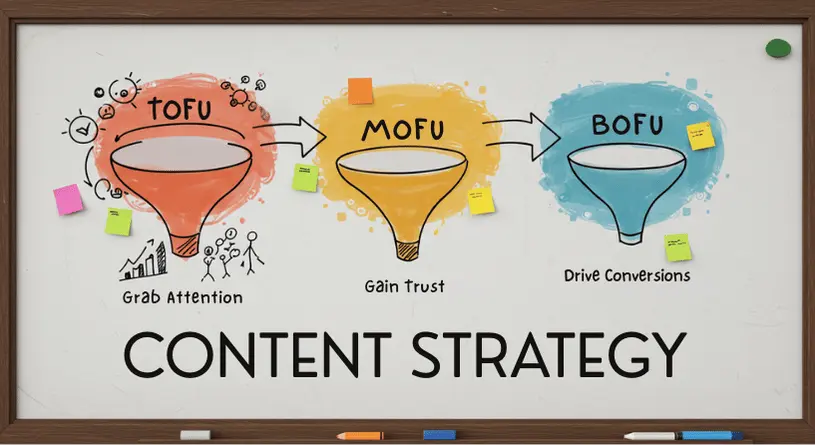
You capture attention with TOFU,
You build trust with MOFU,
You convert to sales with BOFU.
In this article, we will examine these three stages in simple terms and show you step by step how to integrate your content into this structure.
This way, your content doesn’t just get read—it also drives conversions.
1. TOFU: The Stage of Attracting Attention and Initial Contact
Top of Funnel (TOFU)
TOFU is the widest and uppermost part of the sales funnel. The goal here is to attract the attention of people who have never encountered your brand before.
This audience is usually aware of a problem but does not yet know exactly what the solution is. That is why TOFU content focuses on providing information and creating awareness.
Content Purpose:
The purpose of your content in the TOFU stage is to attract new visitors and introduce them to your brand. At this point, the main goal is to attract interest, not to make a sale.
For example, a digital marketing agency can attract the attention of people searching on Google with a blog post titled “What is SEO?”
This content provides a simple, informative, and non-salesy entry point for someone hearing the agency’s name for the first time.
Content Types:
- Blog posts
- Social media posts
- YouTube videos
- Educational podcast episodes
- Informative infographics
How should it be?
TOFU content should be written in simple language that everyone can understand and should not contain any direct sales efforts. It should answer a question that people are looking for, spark interest, and encourage them to interact with your brand for more information.
2. MOFU: The Stage of Building Trust and Deepening Knowledge
Middle of Funnel (MOFU)
At the MOFU stage, the person now knows you. Awareness has been established, and a foundation of trust has slowly begun to be built. At this stage, the user is researching solutions to their problem and evaluating various alternatives. Content now needs to be more detailed and directive.
Content Purpose:
The goal here is to provide the potential customer with the information they need, truly assist them, and thereby earn their trust.
For example, an agency that caught attention with its “What is SEO?” content in the TOFU stage can now offer an e-book titled “How to Build an Effective SEO Strategy” to appeal to users seeking deeper information. This resource demonstrates the agency’s expertise and builds trust.
Content Types:
- E-books
- Comprehensive guides
- Case studies
- Email automation sequences
- Webinars
How Should It Be?
MOFU content should be more in-depth. Readers are no longer just looking for information; they are also questioning why they should trust you.
Therefore, your content should be presented in a professional, valuable, and persuasive manner. The goal is to get readers more interested in your solution.
3. BOFU: Action Promotion and Sales Conversion Stage
Bottom of Funnel (BOFU)
BOFU is the stage where visitors are closest to becoming customers. They are aware of the problem, know the alternative solutions, and are approaching the decision-making process.
The same agency can encourage users to take action at the BOFU stage by offering case studies featuring successful customer examples, free SEO analysis application forms, or a 15-minute free consultation call. The content here now carries a direct “decide now” message.
At this point, your content should directly drive sales and facilitate the decision-making process.
Content Purpose:
To eliminate indecision and encourage potential customers to take action.
Content Types:
- Product introduction videos
- Product comparison tables
- Demo application pages
- Frequently asked questions (FAQ)
- Customer reviews and success stories
How Should It Be?
BOFU content should be clear, concise, and action-oriented. The message to “take action now” should be clearly conveyed to the reader.
They may be asked to click a button, fill out a form, or try the product. In this content, it is as important to build trust as it is to provide the final push to make a decision.
4. Strategic Alignment: Content Should Serve the Right Stage
Each piece of content should address a specific stage of the sales funnel. If content produced for TOFU is overly product-focused, it may scare readers away.
Similarly, if superficial information is still being presented at the BOFU stage, it will be difficult to convince potential customers who are in the decision stage.
Establishing this balance in content planning means delivering the right message to the right person at the right time.
A content strategy that does not take the funnel and its stages into account may distract your target audience and fail to deliver the results you expect.
Summary Table:
| Stage | Expansion | Content Purpose | Content Types |
| TOFU | Top of Funnel | Attract attention, new visitors | Blog posts, social media content, videos |
| MOFU | Middle of Funnel | Build trust, provide information | E-books, case studies, email series |
| BOFU | Bottom of Funnel | Drive sales | Product presentations, price comparisons, demos |

Conclusion
The TOFU, MOFU, and BOFU model transforms content marketing into much more than just random posts.
This structure allows you to systematically manage your communication with potential customers and strategically guide them through the entire process, from awareness to purchase.
Remember that each piece of content is a stop on this journey.
Your goal should not be merely to produce content, but to provide real value to the reader at every stage and move them forward.
Conduct content analysis for your brand:
Where are your gaps? Are you visible in TOFU, do you inspire trust in MOFU, and can you drive conversions in BOFU?
Share your thoughts in the comments, and let’s evaluate your test results together.

 Share
Share X
X ChatGPT
 Perplexity

