
Contents
Consider a user. An email arrives on their phone in the morning and catches their attention. They click on it, read it, and then forget about it. Another user reads the same content and subscribes to your brand. So what was the difference?
This is where the concept of the “customer journey” comes into play.
The customer journey refers to the entire experience a person has with your brand, starting from their first contact with it.
This process consists of stages such as awareness, evaluation, and action, and forms the foundation of your content strategy.
To effectively understand this journey, you need not only quantitative data but also empathy.
Therefore, tools such as “Empathy Maps” and “Customer Journey Maps” guide content creators in better understanding the process and producing user-focused content.
Analyzing your target audience should not be limited to demographic information. To create a truly effective content marketing strategy, you need to understand what your potential customers think, feel, say, and do.
1. Empathy Maps
1.1. What is an Empathy Map?
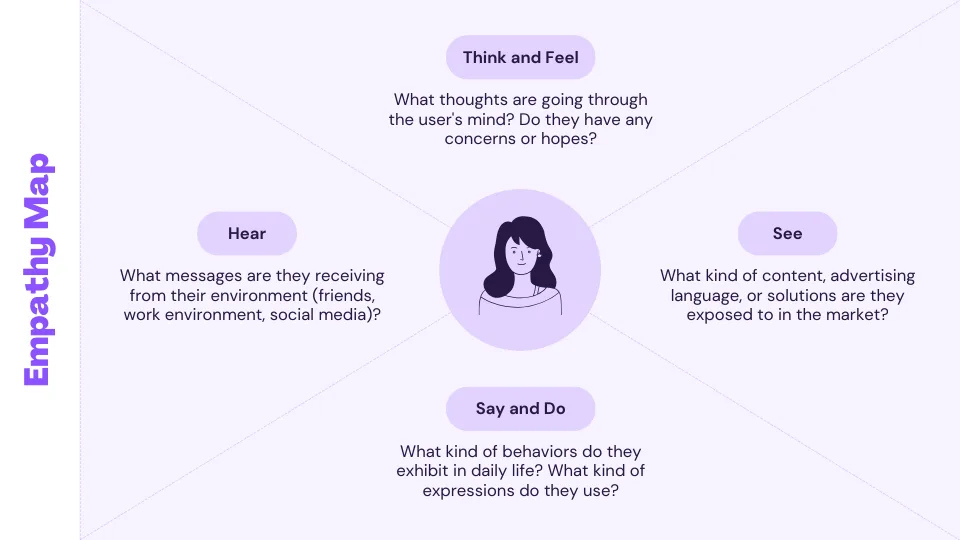
An empathy map is a visual tool that helps you understand the mental and emotional state of a target audience or user persona.
Simply put, an empathy map asks you:
“What does this person feel, think, say, and do when exposed to our product or content?”
It typically consists of four main sections:
- Thinks and Feels: What are the thoughts going on inside the user’s mind? Do they have any concerns or hopes?
- Hears: What messages are they receiving from their surroundings (friends, work environment, social media)?
- Sees: What kind of content, advertising language, or solutions are they exposed to in the market?
- Says and Does: What kind of behaviors do they exhibit in daily life? What kind of expressions do they use?
1.2. Micro Empathy Map Examples
1.2.1. E-Commerce Sector – Fashion Products
Persona: Emma, 29 years old, a white-collar worker in the city. She is accustomed to online shopping. She wants to look stylish but doesn’t want to spend too much time on it.
Empathy Map
| Area | Explanation |
| Thinks & Feels | “Everyone is wearing the same dress, I need to find something different and affordable.” “I wonder if it will really look good on me?” |
| Hears | “This brand’s shipping is very fast.” “The return process is easy.” “This influencer wore it the most.” |
| Sees | Fashion influencers’ Instagram posts, discount highlights in ads, and stylish packaging visuals |
| Says & Does | “I like to dress simply and stylishly.” “I don’t place an order without reading the reviews.” Reviews product videos before shopping. |
Content Opportunities:
- User-generated content such as “How did our customers style this dress?”
- Real user reviews and size comparisons on the product page
- A simple guide video answering the question “How can I return an item?”
1.2.2. Healthcare Sector – Dietitian Service
Persona: James, 35 years old, office worker. He is overweight but has tried many diets before and couldn’t stick to them.
Empathy Map
| Area | Description |
| Thinks & Feels | “Can I succeed this time?” “Will I be hungry again?” “I want to work with someone who understands me.” |
| Hears | “This dietitian keeps track of their clients.” “They listened without judging me.” |
| Sees | Before-and-after photos on social media, “client stories,” motivational content |
| Says & Does | “I’m not disciplined.” “I need a personalized program.” Reviews client feedback and references. |
Content Opportunities:
- Case study: “How did a client like Emre develop sustainable habits in 8 weeks?”
- Q&A-style blog: “Will I go hungry while dieting?”
- Weekly “Client Story” posts on Instagram
1.2.3. Software Industry – Project Management Tool (B2B)
Persona: Olivia, 42 years old, operations manager at an SME-level agency. Her team works in a scattered manner, and she struggles to keep track of their work.
Empathy Map
| Area | Description |
| Thinks & Feels | “The whole team can’t work together. Things keep getting forgotten.” “Setting up a new system is difficult, but maybe this could be the solution.” |
| Hears | “This tool is very user-friendly.” “The support team responds very quickly.” |
| Sees | YouTube videos on “team management in 3 steps,” comparison blogs |
| Says & Does | “We don’t have time to deal with software that will distract us.” Compare at least 3 software options before starting a free trial. |
Content Opportunities:
- A transition guide like “What you need to know before your team switches to Trello”
- A guide on “How to test it best” before the 14-day trial
- Ready-made templates for industry-specific demo requests
Summary:
| Industry | Main Fears | Emotions | Content Type |
| E-Commerce | Trust, body positivity | Appreciation, convenience | Real reviews, product videos |
| Health | Failure, guilt | Feeling safe | Client stories, Q&A |
| Software | Time loss, confusion | Gaining control | Transition guides, comparison content |
1.3. How should you use the empathy map as a content creator?
Thanks to the empathy map, you can shape your content not only to provide information, but also to:
- appeal to the user’s emotions,
- directly address their concerns,
- clear up confusion and instill confidence.
For instance, if a potential customer is thinking, “Is this software secure?” you should incorporate security references into your content by placing this thought on the empathy map.
2. Customer Journey Map
Every customer needs different information at different stages. Content marketing should be geared toward meeting these needs.
A customer journey map is a tool that visualizes all the touchpoints a person goes through from the moment they become aware of your brand until they become a loyal customer. Each touchpoint is an opportunity for content marketing.4

It usually includes the following stages:
Awareness Stage
- The user is aware of the problem and is looking for a solution.
- Content type: At this stage, blog posts, guides, and “how-to” content that can help the user are extremely effective because the user is aware of the problem.
- Purpose: Inform and attract attention
Evaluation Stage (Consideration)
- Alternative solutions are researched and compared.
- Content type: At this stage, e-books, case studies, product comparison tables, and expert opinions are extremely effective in guiding the user as they compare different solutions.
- Purpose: Gain trust and demonstrate expertise
Decision Stage
- The user is now ready to make a decision.
- Content type: At this stage, the user is ready to take action, so trustworthy customer reviews, demo videos, free trials, and promotional offers are extremely effective.
- Purpose: Call to Action (CTA)
Retention & Advocacy Stage
- The user continues to use the product/service and recommends it to others.
- Content type: At this stage, since the user maintains their connection with the brand, email content that retains them and encourages sharing, personalized offers, reward campaigns, and community-focused content are extremely effective.
- Purpose: To maintain customer loyalty.
A successful content strategy provides content suitable for all three stages.
2.1. User Journey Map Creation Guide (5 Steps)
A user journey map helps you visualize the process from a person’s first contact with your brand to becoming a loyal customer. Here are the basic steps you can follow to create one:
2.1.1. Conduct User Research
Purpose: To understand actual user behavior and motivations.
- Conduct surveys, interviews, or collect user feedback.
- Analyze existing user behavior using tools such as Google Analytics, Hotjar, or CRM data.
- Learn when, where, and how users interact with you.
Tip: Rely on data and real user opinions, not your assumptions.
2.1.2. Create Personas (Representative Users)
Purpose: To clarify whose journey you are mapping.
- Create 1-2 characters that reflect your target audience. (Age, occupation, motivation, goals, pain points, etc.)
- Each persona can generate a different journey map.
Example: “Carolina is a 29-year-old teacher. She has limited time and wants quick solutions.”
2.1.3. Identify Touchpoints
Purpose: To identify every point where the user interacts with your brand.
List areas such as websites, blogs, social media, advertisements, emails, and customer service.
What does the user expect, feel, and do at each touchpoint?
Example: “Sees an ad on Instagram → clicks on the website → reviews the product page → adds to cart → purchases → shipping process → returns or leaves a review.”
2.1.4. Add the User’s Emotions and Goals
Purpose: To make the user’s internal experience at each stage visible.
- What is the user feeling at this stage? (curiosity, anxiety, trust, confusion…)
- What is their goal? (solving a problem, learning the price, trying it out, etc.)
- How can your content help with this emotion and goal?
Tip: You can also use the Empathy Map at this step.
2.1.5. Identify Content and Improvement Opportunities
Goal: Produce content appropriate for each stage of the journey and address any gaps.
- Add content that supports the user at each touchpoint.
- Identify missing or confusing points.
- Is the CTA (Call-to-Action) logical? Are the page redirects sufficient?
Example: If a blog post is missing in the awareness stage, prioritize it.
2.2. Sample Customer Journey Stages (Standard)
| Stage | User Status | Content Type |
| Awareness | Aware of the problem but looking for a solution | Blog, guide, social media content |
| Evaluation | Comparing alternatives | E-book, case study, demo |
| Decision | Ready to take action | Price list, reviews, campaigns |
| Loyalty | Using the product/service | Email content, special offers |
2.3. Why is the User Journey Important?
If you don’t analyze these touchpoints in the user journey, you may present the wrong content at the wrong time and lose potential customers.
For example, instead of sending a price list directly to a user who is still in the awareness stage, it is more appropriate to send content that identifies their problem and provides information about the solution.
That’s why creating content specific to each stage is made possible with a user journey map.
3. The Contribution of User Journey to Content Marketing
When you use empathy maps and user journey maps together, you achieve the following:
You analyze your target audience not only based on who they are, but also based on what they experience.
This way, your content becomes not only informative but also engaging, guiding, and transformative.
Now, create your empathy map and identify the gaps in your user journey because creating content without understanding the user is like shooting in the dark.

 Share
Share X
X ChatGPT
 Perplexity

